The complete context layer for AI
The shortest path from SQL to working AI agents.
Quill creates a live context layer on top of your existing SQL database. Your first production agent is weeks away, not years. Your infrastructure stays exactly where you put it.
 PostgreSQL
 SQL Server
 MySQL
MySQL
THE PROBLEM
Companies abandon nearly half of their AI initiatives before they return a cent.
Not because the models fall short, but because the data can't get to them.
S&P Global Market Intelligence, 2025.
TRAP 01
TRAP 02
The business trap
On day one, nobody knows the real scope or use case, not where the value sits. Projects still get scoped big, and most effort goes toward infrastructure and testing, not validating a business case. ROI goes unanswered until the investment is sunk.
The technical trap
A working demo can be misleading. Production means live embeddings, a vector store to run, access control, monitoring, and a compliance review nobody scoped. It routinely takes 18 to 24 months.
Meet Quill
Everything you need to build AI agents on the data you already have. Production-ready from the first touch.
How it works
Nothing moves. Everything improves.
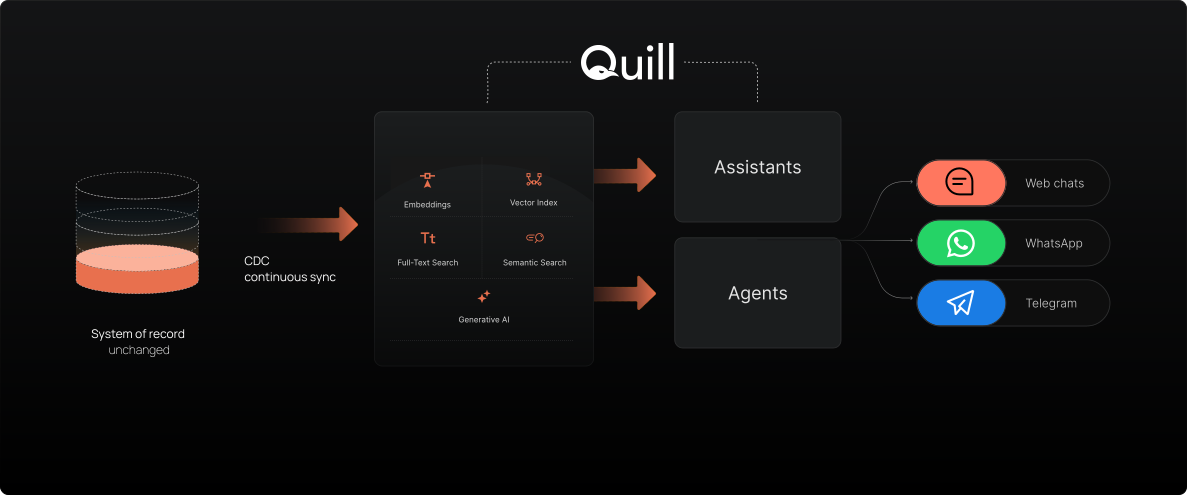
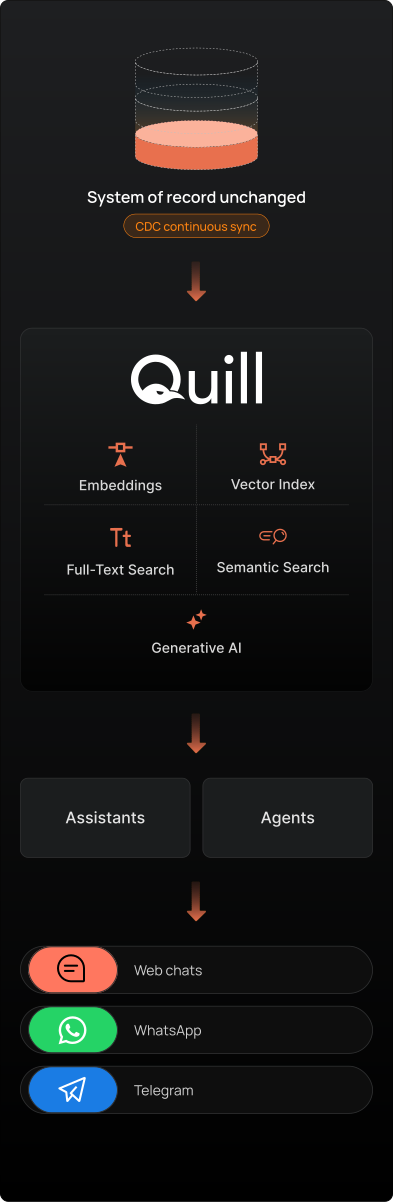
Quill builds a live AI layer on top of your database and keeps it constantly synced, so your agents work on live data they could never reach before. Whenever the data changes, Quill detects it and makes it available for AI use. The layer runs in your environment, holding only what you put in it.
Step 01
Connect to your
existing database
Quill connects to your SQL database and picks up changes in real time. The AI workload runs outside your database, so nothing extra touches production. No migration, and production is untouched.
Step 02
The pipeline
builds itself
As data flows in, Quill does what teams normally assemble by hand: embeddings, vector indexes, full-text search. Nothing to stand up, nothing to tune.
Step 03
Your AI sees what you decide it sees
Only the data an agent needs gets synced into Quill. The synced copy carries its own access rules, and each agent only gets the data its job requires.
Step 04
What you build
on it
Assistants and agents, semantic search, and generative AI pipelines. RAG grounded in current data, not last night's export. One layer feeding all of them.
Assistants
Customers ask about their account, order, or claim in plain language.
"When's my next appointment?" "Order what I had last time." "Why was my claim denied?" Answers come from live operational data.
Agents
Build agents on your data, with the actions they can take defined by you. Scopes are enforced in the layer, so an agent physically cannot reach data it wasn't given.
IN THE BOX
Everything the layer needs, already assembled.
BYOM
Switch providers, self-host, bring your own, or run different models per agent.
Memory that persists
Context carries within and across sessions. No blank slate each time.
Vector search and RAG
Embeddings generated and tuned automatically. No vector DB to run.
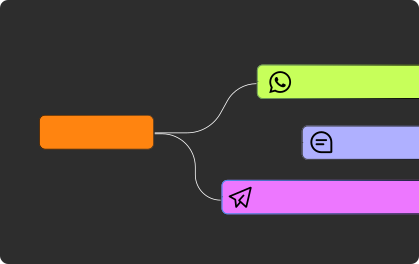
Multi-channel
Web chat, WhatsApp, Telegram, voice. Same layer, different front doors.
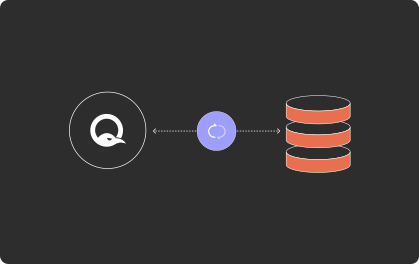
Continuous sync
CDC keeps the layer current. Agents read live data, not last night's export.
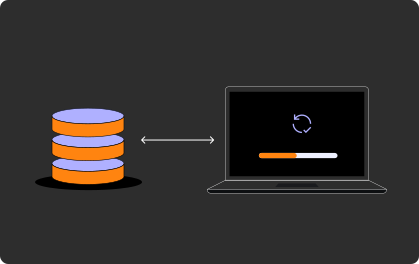
Agents on live data
Configure agents that work with continuously updated data, so they always give the right answer, never one based on a stale snapshot.
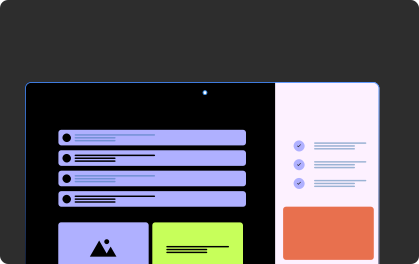
Governed exposure
What isn't synced never reaches the agent. What is synced still follows source permissions, and each agent only gets the slice its job needs.
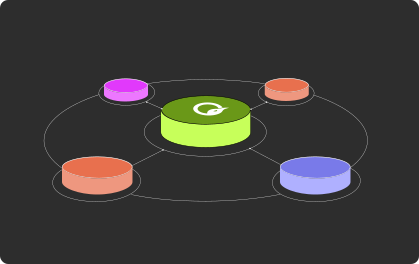
Data from many systems
Expose data from multiple SQL databases through one layer, so agents work from a single, unified picture.
No need for AI team
Quill ships the pipeline, so your existing team goes live in about a week.
See Quill on your
own data.
Spin up a local instance on your own hardware and put an agent on top. Nothing moves, nothing is exposed.
Start FreeThe contrast
Same AI. Same data. Your call.
Both tracks demo an agent in a month - but only one ends there. Quill's work finishes at week 6; the DIY track is still going eighteen months later.
With Quill
ProductionProductionProductionAgent #2Agent #3Agent #4Agent #5Completed!
With DIY stack
- LangChain and glue code to wire it up
- Embedding model and keys
- Vector store and retriever
- Data discovery across systems
- PII, residency, vendor sign-off
- Governance, audit, retention
- Per-user permissions at retrieval
- Ingestion, scheduling, backfills
- Freshness on every source change
- Model churn forces a full re-index
- Golden sets and quality gates
- Tracing, cost and alerting
Comparison
The alternatives, side by side
Each of these can get you somewhere. The question is what it costs and what you're tied to when you arrive.
| Capability | Quill | DIY build | Cloud AI stack | Incumbent's AI |
|---|---|---|---|---|
| Time to production | Weeks | 12 to 24 months | Fast to start, months to actually ship | Blocked by version upgrade, often 12+ months |
| Migration required | No. Your data never leaves your database or your infrastructure, and stays the source of truth | No, but you build the pipeline yourself | Usually yes, data moves to their cloud | No, but AI runs on your production database |
| Full stack out of the box | Yes. Agents, RAG, vector search and generative AI included | No. You build and integrate every layer | Partial. Services exist, you wire them together | Varies, usually a narrow feature set |
| Control what the agent sees | First-class. You configure exactly what each agent can see, scoped per action | It's on you to build and secure, the layer many teams get wrong | Same. Still on you to scope and secure within their tooling | Really hard. It inherits permissions built for people, not agents, so an agent can reach data the person never should |
| Model flexibility | Any model, switch freely, self-host | Possible, but only after you build the abstraction and test every model | Their models only | Locked to the vendor's models and interfaces |
| Runs on-prem | Yes | Yes | No | Depends on the platform |
Questions
The things you'll be asked internally.
No. Quill connects to your existing system (via CDC) and stands up an AI layer alongside it. Your system of record stays where it is and stays authoritative.
Minimal to none. Quill reads changes passively from CDC logs. No heavy queries, no table scans, no vector indexing on your live system.
Quill includes an AI-driven schema analyzer that proposes the translation from your SQL schema to a document model, which you review and adjust before anything syncs.
No. You choose the tables, columns, and rows a use case needs. Everything else never enters the layer.
Your AI keeps reading from the last synced state, so search and answers continue. Actions that write back are queued until the connection returns.
No. Use any provider, switch when you want, or run on your own hardware.
Yes. On-prem is fully supported, which matters for regulated and air-gapped environments.
No. Quill handles search tuning, embeddings, vector search, and sync. Teams are usually productive within about a week.
No. It's a layer on top of the systems you already run.
Your data is ready.
Your database doesn't have to move.
See what production AI looks like on the systems you already run.